Niket Kaushik IPS

05Investigations, Intelligence & Specialist Policing

Follow the information

Investigative policing is a different discipline from enforcement. Enforcement responds to what is visible. Investigation reconstructs what is not — from records, from sequence, from what does not add up.

This page covers the two specialisms that recur through Niket Kaushik's service record: economic offences, in Mumbai's Economic Offences Wing at Deputy Commissioner and later Joint Commissioner level; and anti-corruption, with the Maharashtra Anti-Corruption Bureau at Deputy Inspector General and later Additional Director General level.

The investigative sequence

Intelligence

Information before it is a case. Intelligence is fragmentary by definition and almost never sufficient on its own. Its value lies in direction — telling an organisation where to look, and just as often where not to. Treating it as proof is the most common way investigations go wrong early.

Investigation

The disciplined conversion of information into a case a court can test. It proceeds by establishing sequence, identifying who had knowledge and control at each point, and closing the alternative explanations one by one. Most of it is patient, procedural and unglamorous.

Evidence

What survives challenge. Evidence is not simply what investigators believe to be true; it is what was lawfully obtained, correctly documented, properly preserved and can be shown to be what it claims to be. A break anywhere in that chain removes it, however true it was.

Analysis

Making a pattern legible. In financial and organisational crime the individual facts are usually mundane and lawful in isolation; the offence lives in the relationship between them. Analysis is the work of showing that relationship clearly enough for a non-specialist to follow it.

Accountability

Investigative power is intrusive and therefore tightly bounded. Sanctions, authorisations, time limits and disclosure obligations exist to keep it that way. A specialist unit that treats these as obstacles rather than as the terms of its authority eventually loses cases and, with them, its standing.

01Economic Offences Wing · CID, Brihan Mumbai

Crime without a street

Most policing begins at a place. Economic crime does not. There is no scene to secure, no witness who saw it happen, often no moment at which anything visibly occurred. What exists instead is a record — bank statements, invoices, board minutes, share transfers, registry entries, message logs — and an offence distributed across all of it.

That changes the shape of the investigation completely. The first task is not to find a suspect but to establish what actually happened, in what order, and who held knowledge and control at each step. The individual transactions are usually lawful on their face. The offence, if there is one, is in the pattern.

Three things make this class of work unusually demanding. The evidence is documentary and digital, which means questions of authenticity, custody and admissibility arise constantly. The subject matter is technical, so investigators have to be fluent enough in accounting, corporate structure and banking practice to know which questions are the right ones. And the trail rarely stays inside one jurisdiction or one agency's remit, so progress depends on working with regulators, banks, registries and other investigating agencies.

Cases of this kind also take years, and they are frequently defended by very well-resourced parties. A unit's real capability is measured less by how quickly it registers a case than by whether what it files still stands up at the end.
Scope note. This section describes the field in general terms. No specific case, complainant or accused is discussed anywhere on this site, and no case is attributed to any individual officer.

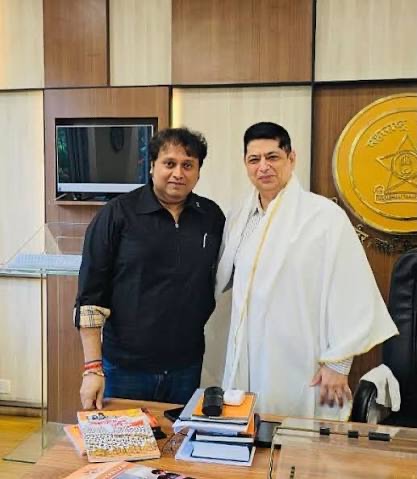
Niket Kaushik, IPS, in his office during a visit, with files and papers on the desk in front of him.
Plate 06At the commissioner's office. Files on the desk are the ordinary material of the work.

There is no scene to secure. There is a record, and an offence distributed across it.

02Maharashtra Anti-Corruption Bureau

Institutional integrity

An anti-corruption bureau is the unusual case of a state agency whose subject is the state itself. Everything about how it works follows from that.

Mandate

What the Bureau does

The Maharashtra Anti-Corruption Bureau investigates offences under the Prevention of Corruption Act across the departments of the state government and the bodies under them. Its jurisdiction is statewide and it operates through divisional and district units, headed at the state level by an officer of Director General or Additional Director General rank.

Prevention

Before enforcement

The preventive side of anti-corruption work is less visible than the enforcement side and arguably more consequential: identifying the processes and discretionary points where corruption becomes possible, and recommending that they be closed, simplified or made transparent. A process that no longer requires a discretionary approval cannot be sold.

Procedure

Due process as the whole point

Investigating public servants requires sanctions and authorisations that ordinary cases do not, and it is scrutinised more closely at every stage. That scrutiny is not an obstacle to the Bureau's work; it is the condition of its legitimacy. An anti-corruption agency whose own procedure is questionable has nothing left to stand on.

Evidence

Proving an agreement

Corruption offences typically turn on demand and acceptance — the hardest thing to establish, because both parties have an interest in silence and there is rarely a document that says what was agreed. Cases are built from corroboration: contemporaneous records, independent witnesses, and the surrounding conduct that makes an innocent explanation implausible.

Confidence

Why it matters beyond the case

The purpose of an anti-corruption institution is not measured only in convictions. It is measured in whether a citizen believes a complaint will be taken seriously, and whether a public servant believes a demand carries real risk. Both of those beliefs are built slowly, through consistency, and lost quickly.

Record. Niket Kaushik has served with the Maharashtra Anti-Corruption Bureau on two occasions: at Deputy Inspector General level — the rank recorded against his name in the Republic Day 2012 Police Medal award list — and later as Additional Director General of Police heading the Bureau, the appointment held immediately before his current posting. Not published here: any individual case, complainant, accused or operational method.

03Editorial Standard

How work is attributed on this site

Police outcomes are almost never the work of one person. This site distinguishes four levels of involvement and does not blur them.

Level 01

Personal. An appointment held by the officer, recorded in an official posting list. Everything on this site is at this level.

Level 02

Unit. Work done by a unit during a period an officer commanded it. Not attributed to the officer personally.

Level 03

Department. Work of the wider police organisation. Never presented as an individual achievement.

Level 04

State. Operations involving multiple agencies and government departments. Outside the scope of an individual profile.

Consequence. Because no case has been verified at Level 01 against an authoritative record, no case study appears on this site. Career facts, dates and awards are published; operational claims are not.

Next

The citizen at the centre

Accessibility, response, dignity and communication — the part of policing most people actually encounter.

Public service